
Betting Regulation
Paripesa License and Regulatory Status Explained
A detailed look at Paripesa's Curacao license, compliance measures, and player protections.

Sports Betting Analyst & Football Predictions Expert
Brian Otieno is a Kenyan sports betting analyst with over 10 years of experience in football predictions, match analysis, and betting strategies. He specializes in European football leagues, statistical analysis, odds comparison, and identifying value betting opportunities. His approach combines data-driven insights, team performance research, and disciplined bankroll management to help sports enthusiasts make more informed betting decisions.
Paripesa operates under a Curacao eGaming license, one of the most common regulatory frameworks in the online betting industry. The license number 8048/JAZ2018-040 is issued to the platform's operator, Vezzali Limited, a company registered in Cyprus. This licensing arrangement allows Paripesa to offer sports betting and casino services across numerous international markets, though the specific legal standing varies significantly depending on where a player resides.
Contents
- 1. What License Does Paripesa Hold
- 2. Curacao eGaming License Details
- 3. How the License Affects Players
- 4. Regulatory Compliance and Audits
- 5. Player Protection Measures
- 6. Country Restrictions and Access
- 7. Verification and KYC Requirements
- 8. Responsible Gambling Tools
- 9. Dispute Resolution Process
- 10. Comparing Paripesa's License to Other Regulators
- 11. Recent Regulatory Developments
- 12. Practical Implications for Different Player Types
- 13. Final Assessment of Paripesa License
The Curacao license has been a fixture in online gambling since 1996, making it one of the oldest regulatory regimes still in operation. Unlike licenses from the UK Gambling Commission or Malta Gaming Authority, Curacao operates under a master license system where sub-licenses are granted to operators. This structure means Paripesa's oversight comes through the master license holder rather than directly from the Curacao government, a distinction that affects how complaints are handled and what enforcement mechanisms exist.
For players, the practical implications of this licensing choice are mixed. On one hand, the Curacao framework permits Paripesa to accept cryptocurrency payments, offer a wide range of betting markets, and operate in countries where more restrictive regulators would block access. On the other hand, the player protection standards are generally considered less stringent than those imposed by top-tier European regulators. Dispute resolution, fund segregation requirements, and responsible gambling mandates all differ in ways that matter when something goes wrong.
What License Does Paripesa Hold
Paripesa's primary license is the Curacao eGaming sub-license 8048/JAZ2018-040. The master license 8048/JAZ is held by Antillephone N.V., one of the four original master license holders authorized by the Curacao government in 1996. Vezzali Limited, the Cyprus-registered entity operating Paripesa, holds the sub-license. This corporate structure is standard for Curacao-licensed operators — a European holding company with the actual license granted through the Caribbean jurisdiction.
The license covers both sports betting and online casino operations under a single authorization. This is a key feature of the Curacao system — one license encompasses all gambling verticals, unlike some jurisdictions that require separate licenses for betting, casino, poker, and lottery products. For Paripesa, this means their sportsbook, live betting, virtual sports, esports, slots, live casino, and instant games all fall under the same regulatory umbrella.
License verification is straightforward. Players can check the license status by visiting the Curacao eGaming validation page and entering the license number. The public record shows the license holder, issue date, and current status. As of the last public verification, the license remains active. However, the Curacao registry does not publish detailed compliance histories, enforcement actions, or financial audit results — information that regulators like the UKGC or MGA make routinely available.
Curacao eGaming License Details
The Curacao licensing regime operates under the National Ordinance on Offshore Games of Hazard (LOK), originally enacted in 1993 and updated in 2002. The framework was designed to attract international operators with a streamlined application process, favorable tax treatment, and a single license covering all gambling activities. The corporate tax rate for licensed operators is 2% on net profits, with no VAT on gambling services — significantly lower than most European jurisdictions.
Master license holders like Antillephone N.V. pay an annual fee to maintain their status and are authorized to issue sub-licenses to operators. The sub-license application requires corporate documentation, beneficial ownership disclosure, software certification from approved testing labs, and proof of domain ownership. The process typically takes 6-8 weeks, compared to 6-12 months for a UKGC or MGA license. This speed is a major reason operators choose Curacao.
Ongoing compliance obligations under the Curacao license include maintaining certified RNG software, submitting periodic financial reports, implementing basic AML/KYC procedures, and providing a dispute resolution channel. However, the depth of these requirements is notably lighter than top-tier regulators. There is no mandatory player fund segregation into separate trust accounts, no requirement for independent dispute resolution through an approved ADR provider, and no prescribed responsible gambling toolset beyond self-exclusion.
The license also permits cryptocurrency gambling, which many European regulators either prohibit or heavily restrict. Paripesa accepts Bitcoin, Ethereum, USDT, and other cryptocurrencies for both deposits and withdrawals. This capability is directly tied to the Curacao framework's permissive stance on payment methods, provided the operator implements adequate AML controls. For players in regions with restricted banking access to gambling sites, this is a significant practical advantage.
How the License Affects Players
The most immediate effect of Paripesa's Curacao license is accessibility. The platform accepts players from over 100 countries, including many where locally licensed operators are scarce or non-existent. India, Bangladesh, Nigeria, Kenya, Brazil, and numerous other markets can access Paripesa without VPNs or mirror sites. This broad availability is a direct consequence of Curacao's international orientation and the lack of country-specific blocking requirements that stricter regulators impose.
However, accessibility cuts both ways. In countries with established gambling regulations — the UK, Germany, Sweden, Spain, Italy, France, Netherlands, and others — playing on a Curacao-licensed site like Paripesa is technically illegal for residents. These jurisdictions require operators to hold a local license to serve their citizens. Players in regulated markets who use Paripesa have no legal recourse through their national courts or regulators if disputes arise. The Curacao license offers no protection in those jurisdictions.
For players in unregulated or grey markets, the Curacao license provides a baseline of legitimacy. It confirms the operator has passed basic vetting, uses certified software, and maintains a registered corporate entity. But the protections are thin. There is no compensation scheme if the operator becomes insolvent. Dispute resolution runs through the operator's internal process, then potentially to the master license holder, with no independent adjudicator. Withdrawal delays, bonus disputes, and account closures are handled at the operator's discretion within broad guidelines.
Regulatory Compliance and Audits
Paripesa's compliance obligations center on three areas: software fairness, anti-money laundering, and basic operational standards. The platform's games and betting odds are supplied by third-party providers — companies like Evolution, Pragmatic Play, NetEnt, and dozens of others — each of which holds its own certifications from testing labs such as eCOGRA, iTech Labs, or GLI. Paripesa itself does not develop games, so the fairness certification chain runs through its providers rather than through a direct audit of Paripesa's systems.
AML compliance follows the Curacao framework's requirements, which align with FATF recommendations at a high level but lack the granular transaction monitoring and reporting mandates of EU directives. Paripesa implements KYC verification at withdrawal thresholds, typically triggering document requests at €2,000 cumulative withdrawals or when suspicious activity is detected. The verification process requires government-issued ID, proof of address, and sometimes source of funds documentation. This is standard for Curacao operators but less rigorous than the ongoing monitoring required in regulated European markets.
Financial audits under the Curacao license are not publicly disclosed. The master license holder receives periodic reports, but there is no public registry of audit findings, capital adequacy ratios, or player fund segregation verification. This opacity makes it difficult for players to assess the operator's financial health. In contrast, UKGC-licensed operators must publish annual financial statements and demonstrate continuous segregation of player funds from operational accounts.
Player Protection Measures
Paripesa provides a set of responsible gambling tools that meet the Curacao license minimums but do not exceed them significantly. Players can set deposit limits (daily, weekly, monthly), loss limits, wager limits, and session time limits. Self-exclusion options range from 24 hours to permanent account closure. A reality check feature displays session duration at configurable intervals. These tools are accessible through the account settings menu and take effect immediately upon activation.
Notably absent are features mandated by stricter regulators: affordability checks, mandatory cooling-off periods after self-exclusion reversal, proactive intervention based on play patterns, and integration with national self-exclusion schemes like GamStop (UK), Spelpaus (Sweden), or ROFUS (Denmark). Paripesa does not participate in any cross-operator exclusion database. A player self-excluded from Paripesa can immediately open an account at another Curacao-licensed site.
The platform displays standard responsible gambling messaging and links to external help organizations — GamCare, Gambling Therapy, Gamblers Anonymous. However, these are generic links rather than integrated referral pathways. There is no evidence of mandatory staff training on problem gambling identification, no dedicated safer gambling team disclosed publicly, and no published data on tool utilization rates or intervention outcomes. The approach is reactive rather than proactive.
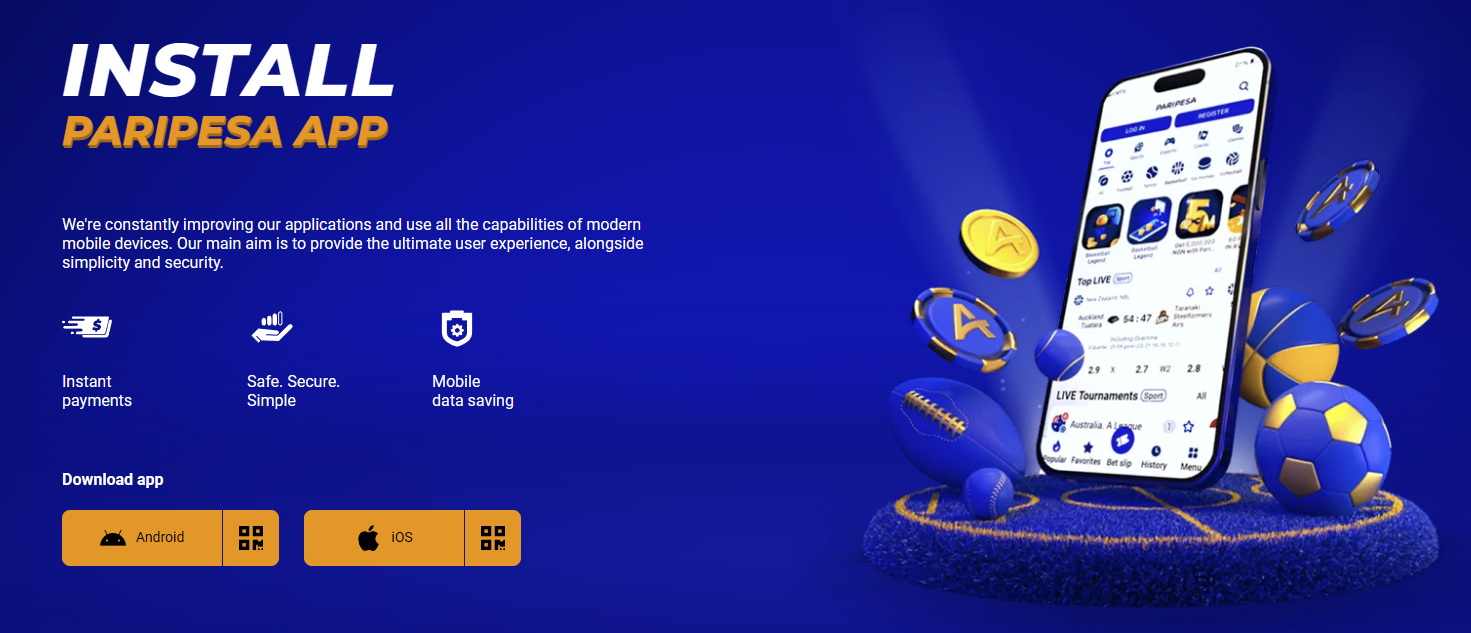
Age verification occurs at registration through a simple checkbox confirmation, with documentary verification deferred to the first withdrawal. This delayed verification approach is common among Curacao operators but would not satisfy regulators requiring age verification before any gambling activity. The risk of underage access is therefore higher during the period between registration and first withdrawal attempt.
Country Restrictions and Access
Paripesa maintains a restricted countries list that includes the United States, United Kingdom, France, Netherlands, Spain, Italy, Germany, Sweden, Portugal, Poland, Czech Republic, Slovakia, Hungary, Romania, Bulgaria, Cyprus, Malta, Israel, Iran, North Korea, Syria, Sudan, and several others. The list is enforced through IP geo-blocking at the website level. Players from restricted countries attempting to access the site receive a message stating the service is unavailable in their region.
The restriction logic follows a practical rather than strictly legal framework. Paripesa blocks countries where either local law explicitly prohibits unlicensed operators or where the operator has chosen not to operate due to regulatory risk. Some countries on the list — like the UK, Germany, Sweden — have clear licensing regimes that Paripesa does not comply with. Others may be blocked due to payment processing difficulties, sanctions, or business decisions rather than explicit legal prohibitions.
Players in restricted countries sometimes bypass blocks using VPNs, but this creates significant risks. Account verification will eventually require documents proving residence in an allowed country. Using false documents constitutes fraud and gives the operator grounds to void winnings and close the account. The Curacao license does not protect players who violate territorial restrictions, and the master license holder will not intervene in such cases.
Verification and KYC Requirements
Paripesa's KYC process follows a tiered approach. Initial registration requires only email, phone, and basic personal details. Full verification triggers at the first withdrawal request or when cumulative withdrawals approach €2,000. The standard document package includes a government-issued photo ID (passport, national ID, or driver's license), proof of address (utility bill or bank statement no older than three months), and a selfie with the ID for facial verification.
Additional verification may be requested for high-value transactions, suspected bonus abuse, or payment method validation. Source of funds documentation — bank statements showing income, payslips, business revenue records — can be required for withdrawals exceeding €10,000 or when play patterns suggest professional gambling. The operator reserves the right to request video verification calls in exceptional cases. These escalation tiers are consistent with Curacao AML guidelines but applied at the operator's discretion.
Verification typically completes within 24-48 hours during business days. Delays occur when documents are unclear, expired, or inconsistent with registration data. Players from countries with non-Latin scripts sometimes face additional delays due to translation requirements. The operator accepts documents in English, Russian, Spanish, Portuguese, Hindi, and several other languages, but less common languages may require certified translations at the player's expense.
Responsible Gambling Tools
The responsible gambling toolkit available to Paripesa players includes deposit limits, loss limits, wager limits, session limits, reality checks, temporary self-exclusion (24 hours to 6 months), and permanent self-exclusion. Limits can be decreased immediately but increases require a 24-hour cooling-off period — a standard protection against impulsive limit removal. Self-exclusion is irreversible for the selected duration; accounts cannot be reopened early under any circumstances.
A notable gap is the absence of a net loss limit across all products. Deposit limits apply per payment method, not holistically. A player could theoretically deposit the maximum via multiple payment methods and exceed a intended budget. Loss limits track net losses but reset based on the selected period (daily, weekly, monthly) rather than rolling windows. Session limits log the player out but do not prevent immediate re-login.
The platform does not offer voluntary transaction blocks for gambling-specific merchant categories, a feature some banks and e-wallets provide independently. There is no integration with third-party blocking software like Gamban or BetBlocker at the platform level. Players seeking comprehensive exclusion must rely on device-level or network-level tools rather than operator-enforced barriers.
Dispute Resolution Process
When disputes arise, Paripesa's internal process is the first and often only recourse. Players submit complaints through customer support — live chat, email, or the website contact form. The operator aims to resolve issues within 14 days, though complex cases involving bonus terms, suspected fraud, or technical errors can take longer. There is no published service level agreement with binding deadlines.
If internal resolution fails, players can escalate to the master license holder, Antillephone N.V., through their complaint form. Antillephone reviews whether the operator followed its own terms and conditions and Curacao licensing requirements. They do not adjudicate on fairness of game outcomes, bonus term interpretation beyond clear violations, or commercial disputes. Their remedy is limited to instructing the operator to comply with license conditions; they cannot award compensation.
No independent alternative dispute resolution (ADR) body is mandated or provided. This is a critical difference from UKGC and MGA licenses, which require operators to partner with approved ADR providers like eCOGRA, IBAS, or the Malta Arbitration Centre. Those bodies issue binding decisions and can award compensation up to specified limits. Paripesa players have no equivalent pathway. Legal action in the player's home jurisdiction is theoretically possible but practically difficult due to jurisdiction clauses in the terms of service.
Comparing Paripesa's License to Other Regulators
The Curacao license sits at the permissive end of the regulatory spectrum. Compared to the UK Gambling Commission, the differences are stark: UKGC requires player fund segregation in trust accounts, mandatory ADR, affordability checks, 24-hour cooling-off for limit increases, participation in GamStop, quarterly financial reporting, and proactive safer gambling interventions. Paripesa meets none of these requirements under its current license.
The Malta Gaming Authority occupies a middle tier — stricter than Curacao but more internationally oriented than national regulators. MGA requires player fund segregation, approved ADR, responsible gambling tools with proactive monitoring, corporate governance standards, and regular compliance audits. MGA-licensed operators can serve many European markets through mutual recognition agreements. Paripesa's Curacao license provides no such market access.
At the same tier as Curacao are licenses from Anjouan, Costa Rica, Kahnawake, and Panama. These jurisdictions offer similar frameworks: single license for all verticals, low taxes, fast issuance, minimal ongoing oversight, and limited player protections. Operators choose among them based on cost, reputation, payment processor acceptance, and target market compatibility. Paripesa's choice of Curacao reflects its established reputation and broad payment processor support rather than any unique advantage.
Recent Regulatory Developments
Curacao's gambling regulatory framework is undergoing its most significant overhaul since 1996. The new National Ordinance on Games of Chance (LOK 2024) was passed in 2023 and begins phased implementation in 2024-2025. Key changes include a new Gaming Authority replacing the current master license system, direct licensing of operators by the Authority, mandatory player fund segregation, required ADR participation, enhanced AML obligations, and a centralized player exclusion register.
For existing license holders like Paripesa, a transition period applies. Sub-license holders must apply for new direct licenses under the Authority, demonstrating compliance with the enhanced standards. The transition deadline is currently set for mid-2025, though extensions are possible. During transition, existing sub-licenses remain valid. The practical impact on Paripesa's operations will depend on how the new Authority interprets and enforces the updated requirements.
The reform aims to address longstanding criticism that Curacao's framework enables rogue operators and provides insufficient player protection. If implemented effectively, the new regime could bring Curacao closer to MGA standards. However, the Authority's capacity, independence, and enforcement willingness remain untested. Players should monitor whether Paripesa successfully transitions to the new license and what operational changes accompany it.
Simultaneously, several major markets have intensified enforcement against unlicensed operators. The Netherlands, Germany, and Sweden actively block and prosecute Curacao-licensed sites targeting their residents. Payment processors face fines for facilitating transactions. This trend reduces the practical accessibility of Curacao licenses in regulated markets, regardless of the license's theoretical international validity.
Practical Implications for Different Player Types
Recreational bettors in unregulated markets generally find Paripesa's Curacao license adequate for their needs. The platform functions reliably, pays winnings, and offers competitive odds and bonuses. The lack of advanced protections rarely affects players who gamble within their means and understand the terms. For this group, the license's permissiveness — crypto payments, broad market access, generous bonuses — outweighs the regulatory gaps.
High-volume or professional players face greater risks. Large withdrawals trigger enhanced KYC, source of funds requests, and potential account restrictions. The absence of fund segregation means player balances are unsecured creditor claims if the operator becomes insolvent. No compensation scheme exists. Dispute resolution for six-figure disputes relies entirely on the operator's goodwill or costly international arbitration. Professionals typically prefer MGA or UKGC licenses for these reasons.
Players with gambling problems encounter the weakest safety net. Self-exclusion is operator-only, easily circumvented by opening accounts elsewhere. No affordability checks intervene before losses accumulate. No proactive outreach occurs when play patterns indicate harm. The responsible gambling tools exist but require self-awareness and initiative to activate. Vulnerable players in unregulated markets have significantly less protection than those in jurisdictions with mandatory safer gambling frameworks.
Final Assessment of Paripesa License
Paripesa's Curacao license is a legitimate, verifiable authorization that allows the platform to operate legally under Curacao law and serve players in many countries where no local license exists. It provides a baseline of operational standards — certified software, basic AML/KYC, a corporate entity subject to some oversight — that distinguishes licensed operators from completely unregulated ones. For players in grey markets, this baseline matters.
The license's limitations are equally real. Player protections are minimal compared to top-tier regulators. Fund segregation, independent dispute resolution, proactive harm prevention, and compensation schemes are absent. The regulatory framework is in transition, with significant upgrades planned but not yet implemented. Players in regulated markets (UK, EU, etc.) have no legal protection when using Paripesa and violate local law by doing so.
The practical verdict depends entirely on the player's location and priorities. In India, Bangladesh, Nigeria, Brazil, and similar markets, Paripesa's license enables a functional, feature-rich betting experience that local alternatives often cannot match. In Germany, Sweden, or the UK, the same license signals an illegal operator with no accountability to local authorities. There is no universal answer — only a clear-eyed assessment of what this specific license does and does not provide for each individual situation.
Frequently Asked Questions
What license number does Paripesa hold?
Paripesa operates under Curacao eGaming sub-license 8048/JAZ2018-040, issued to Vezzali Limited through master license holder Antillephone N.V.
Is Paripesa legal in my country?
Legality depends on your country's gambling laws. Paripesa blocks access in many regulated markets like the UK, Germany, France, and Netherlands. In unregulated markets, it operates in a legal grey area — not explicitly licensed locally but not explicitly prohibited either.
Does the Curacao license protect my funds if Paripesa goes bankrupt?
No. The Curacao license does not require player fund segregation into trust accounts. Your balance becomes an unsecured creditor claim in insolvency proceedings, with no compensation scheme.
Can I file a complaint with a government regulator about Paripesa?
You can complain to Antillephone N.V., the master license holder, but they have limited enforcement power. There is no independent ADR body. In regulated markets, your national regulator has no jurisdiction over Curacao-licensed operators.
Will Paripesa's license change under Curacao's new regulations?
Yes. Curacao's new Gaming Authority begins phased implementation in 2024-2025. Existing sub-license holders must transition to direct licenses with enhanced requirements including fund segregation and mandatory ADR. The transition deadline is mid-2025.
Does Paripesa participate in GamStop or other national self-exclusion schemes?
No. Paripesa only offers its own self-exclusion, which applies only to Paripesa accounts. It does not integrate with GamStop (UK), Spelpaus (Sweden), ROFUS (Denmark), or any cross-operator exclusion database.
Are Paripesa's games fair under the Curacao license?
Paripesa uses third-party game providers (Evolution, Pragmatic Play, etc.) that hold independent RNG certifications from labs like eCOGRA and iTech Labs. The fairness chain runs through providers rather than a direct Paripesa audit.
Can I use a VPN to play on Paripesa from a restricted country?
Technically possible but risky. Account verification requires proof of residence in an allowed country. Using false documents constitutes fraud and gives Paripesa grounds to void winnings and close your account permanently.